MINI Launches New USB Flash Drives for the Car Gadget Geeks


For all you MINI fans and car gadget geeks, BMW’s British subsidiary has released a new collection of USB flash drives. The data storage devices come in three unique shapes: an 8GB stick in the form of a MINI ignition key with an illuminated ring; a 4GB unit in the shape of a bulldog, which is said to reflect the firm’s British heritage, and a dual-purpose liquid mouse with a white MINI miniature swimming around in a two-tone, transparent orange fluid. More photos after the jump.


PHOTO GALLERY

Playseats’ Red Bull F1 Game Simulator is the Coolest Way to Race in Your Living Room


Playseats, a Netherlands-based gaming seat company, has signed a licensing agreement with Red Bull Racing for the creation of a pricey but admittedly cool new F1 game simulator. Designed and developed by Playseats, the simulator is branded with the Red Bull Racing logo and sports the Austrian racing team's F1 colors.

The Playseat F1 is said to reproduce the exact driving position of a Formula 1 car and is compatible with all steering wheel and pedal sets on the market. It can be used in combination with any PC or game consoles including the PS2, PS3, Xbox, Xbox 360 and Wii.

The seat is upholstered in Black vinyl that imitates high quality leather and has a red double stitching design. It also has a fully adjustable Black coated steel framework and a G27 gearshift support.

“The time that people raced, perched on a kitchen chair with a racing wheel clamped to the table, have been gone for some time now. But the new Playseat formula takes virtual racing to a completely new level. The interaction with the racing game is unrivalled. The user feels every bump in the road surface. People will experience the race as if they are real racing drivers,” said Playseats founder Fernando Smit.

Although the Playseat F1 game seat will be available from May 2011, the company says it has already taken orders from unnamed Formula 1 drivers. The price for the Red Bull-branded Playseat F1 is €950 ($1,325), while the unbranded version retails for €827 ($1,115).

By Dan Mihalascu


PHOTO GALLERY

Chrysler Launches New “Imported from Detroit” Merchandise – And no, They’re Not Made in China…


Chrysler has released a new dedicated lineup of clothes and apparels featuring the brand’s “Imported from Detroit” motto, which first appeared on the 200 Super Bowl commercial with Eminem. And yes, the possibility that the merchandise may not be made on this side of the world did cross our minds too, but Chrysler’s website put those dastardly doubts to rest stating that the clothes and apparels are all made in the USA.

The "Imported from Detroit" logo features the wings from the Chrysler emblem with the Detroit Fist in the center, which according to the company, symbolizes the automaker's comeback.

“The Chrysler brand, the company and its employees have adopted the principle that failure is not an option – this merchandise reflects that spirit and attitude. The entire company is proud that we are manufacturing and producing products that embody beauty and quality such as the 2011 Chrysler 200,” said Chrysler brand CEO Olivier Francois.

The "Imported from Detroit" collection includes T-shirts, hoodies, caps, ladies tank tops, infant clothes and bumper stickers. Prices range from $6 for the stickers to $55 for the full-zip style hoodie. The automaker said new designs and merchandise are to be added to the lineup throughout the year.

According to Chrysler, part of the proceeds will be donated to four Detroit-based charities: Boys & Girls Clubs of Southeastern Michigan, Habitat for Humanity Detroit, The Marshall Mathers Foundation and Think Detroit PAL.


VIDEO


_______________________________________________________________________


PHOTO GALLERY

BMW’s M Division Presents its First Ever Bicycle, the Carbon Racer


Initially created to facilitate BMW’s racing program, the Bavarian firm’s M Gmbh division gradually expanded its activities to include the development and manufacturing of the company’s sportiest production cars, and more recently, crossover and SUV models as well. Now, the M brand is entering new territory with the introduction of its first racing bicycle, the M Bike Carbon Racer.

The highlight of the bicycle is the lightweight carbon frame that has been developed in-house by BMW’s M division. The German company states that the frame is extremely light and stiff, absorbs shocks, and is absolutely corrosion-free. The bicycle also comes equipped with Shimano Ultegra gears and tips the scales at just 7.4 kg or 16.3 pounds.

The frame is finished in an anthracite carbon look, while the colored accents on the rims, handlebar grips, and saddle inlay are painted in the typical BMW M red color.

Prices have not yet been released, but BMW said that the M Bike Carbon Racer will be available from select dealers as well as online on the firm’s website from June 2011.


BMW M Bike Carbon Racer (anthracite)
Frame height: 52 cm, 54 cm, 56 cm, 58 cm, and 60 cm
Frame: Full carbon with BMW M logo
Rear derailleur: Shimano Ultegra RD-6700
Front derailleur: Shimano Ultegra FD-6700
Cassette: Shimano CS6700, 11–28 sprockets, ten-speed
Weight: 7.4 kg


PHOTO GALLERY

French Hybrid Design Study Uses Wind Turbines To Recharge Batteries


Remember a few years ago when every wannabe gangsta was buying those awful “spinner” alloys for their beat up old Chevys and Oldsmobiles? Well, French artist and teacher Thierry Dumaine (who sounds like a character from a historical romance) has taken the concept of the spinner and applied it to an imaginary hydrid he calls the Ventile.

It’s all very simple. You know those bicycles that have pedal powered lights? Same principle, though in this case the fans are turned by the circular motion of the wheels and not by being affixed to the wheels themselves.

The fans power a generator that helps recharge the Ventile’s batteries. I don’t know how well this would work in the real world, mostly due to the Law of Conservation of Energy, but really who cares.

The Ventile is a sweet looking ride; sort of like the result of a 1930’s Ford being reinvented by MINI. There’s also a large underbody fan that is turned by air rushing over the vehicle’s underside; a far more realistic prospect for energy production. It’s not unlike that wind turbine car those two Germans used to cross Australia a few weeks back.

Dumaine’s creation was an entrant in the 2011 Michelin’s Challenge Design showcase, an annual exhibition of new automotive design talent on the web. You can check out our gallery below.

By Tristan Hankins


PHOTO GALLERY


VIDEO: This is How They Imagined Our Automobile Future in 1948


In the late 1940s, as the world started to recover from the wounds of war, people were trying to leave the past behind and focus on the future. In fact, some individuals were so fascinated with the future that they tried to tune in it and predict the outcome. In this nostalgic video, we see how some people imagined the future of automobiles in 1948. Watch the clip after the break.


VIDEO

A Future of Smarter Cars as Automakers and Regulators Seek to Cure Driver Error


In 2010, “unintended acceleration”, a phrase that had been somewhat forgotten in the automotive lexicon returned to the hearts and minds of many Americans. After exhausting research by the NHTSA and other independent agencies, the culprit was found to be a combination of poorly designed floor mats, “sticky” accelerator pedals...and driver error.

As our roads become more congested and the traffic rules more and more complicated, incidents of driver error resulting in accidents are likely only to increase. The solution: smarter electronics that take the “driver” out of “driver error”.

Things like electronic systems that cut power to the car when drivers hit both the brake and gas pedals, rear vision cameras, electronic data recorders and even wireless monitoring of the vehicle’s performance are set to become increasingly commonplace in the coming decades.

There are other less sophisticated measures: such as driver training and a subtle reworking of driver ergonomics that could reduce the number of or even prevent such accidents from occurring in the future. It’s all well and good, but it does hint at the low opinion both regulators and automakers have of the average car driver.

By Tristan Hankins

Via: Wall Street Journal


Ford Brings SYNC Technology to Europe Starting with the New Focus


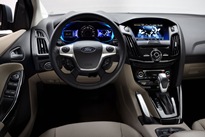
Ford will offer the infotainment and connectivity system to its European models starting from 2012, the company announced today. The all-new Focus will be the first vehicle in Europe to feature the SYNC technology, with other models to follow. Ford said it wants to have 2 million SYNC-equipped cars on European roads by 2015.

The voice-control technology will be available in 19 languages: U.S., U.K. and Australian English, European and Canadian French, European and U.S. Spanish, European and Brazilian Portuguese, German, Italian, Dutch, Russian and Turkish. Beyond Europe, languages such as Arabic, Korean and Japanese are also compatible with SYNC.

The system can recognize 10,000 commands in each of the 19 languages, giving drivers the power to control most of the vehicle's functions using their voice. “SYNC’s unique connection between the driver’s devices and the vehicle means that the user’s voice can control both the car and the device. It is being developed specifically for European customers with the ability to understand multiple languages and accents," said Jason Johnson, SYNC Product Development engineer.

SYNC is able to connect to mobile phones via Bluetooth, playback media acquired via USB-ports and even act as a mobile WiFi hotspot for the car's passengers. “It is a smarter, safer and simpler way to connect drivers with in-car technologies and their digital lives,” said Ford's CEO Allan Mulally, who will announce SYNC's expansion to Europe at the 2011 CeBIT technology show in Hannover, Germany.

By Dan Mihalascu


_______________________________GALLERY_______________________________
FocusElectric_SYNC000Alan Mulally Visits Ford Display at This Year's NADA ConventionFocusElectric_SYNC002

Chevy Launches MyLink Infotainment System in Response to Ford's SYNC


The 2012 Chevrolet Volt and Equinox models will be the first to offer Chevy MyLink, an in-car infotainment equipment that integrates internet radio, hands-free, voice and touch-screen controls, all of which can be accessed via Bluetooth connectivity.

Three years ago, Ford introduced a similar system, called SYNC, whose aim was to reunite in a friendly and efficient way the various in-car controls that a driver can access while driving. Now Chevy is ready with its own technology, developed together with GM's subsidiary OnStar.

MyLink provides drivers with stereo audio streaming, wireless control of smartphones, voice-activated commands and a full-color 7-inch touch screen display that centralizes media sources. For example, the driver can initiate phone calls, select radio stations or stored media only by using his voice.

Other features are Pandora internet radio, which allows users to personalize their radio experience, or Gracenote, which identifies the user's music collection and presents information such as artist name, genres and album cover art on the MyLink screen.

Basically, MyLink does everything that SYNC does, plus the future integration of the Powermat wireless cell-phone charging system that eliminates cords. The MyLink infotainment system will expand to other Chevrolet models in the next 18 months.

By Dan Mihalascu


_______________________________GALLERY_______________________________


 
Design by Blogger | New Cars Company